
 +39 0816132412
  donatella.dellecave@igb.cnr.it
- Research Interest
- Selected Publications
- Professional Experience
Pancreatic ductal adenocarcinoma (PDAC) is characterized by a dense, fibrotic tumor microenvironment that drives therapy resistance and metastasis. Our research is focused on deciphering the “matrisome code”, the network of extracellular matrix proteins secreted by tumor and stromal cells, to understand how it shapes tumor progression. Using multi-omics, CRISPR/Cas9, patient-derived organoids, and mouse models, we aim to: identify key extracellular matrix components, characterize the metabolic profiles of primary matrisome-secreting cells, inhibit matrisome secretion to enhance chemotherapy efficacy, and validate these findings in preclinical studies to improve patient outcomes.
TGF-beta1-mediated downregulation of L1CAM in pancreatic ductal adenocarcinoma drives upregulation of collagen 17A1 and MMP2, facilitating tumor invasiveness and metastasis. Delle Cave D. (first and corresponding author), Di Domenico A., Fantuz M., Ciotola M., Mangini M., Buonaiuto S., Corrado B., Corona M., Saracino F., Andolfi G., Di Biase I., Cucciardi A., Carrer A., Sainz B Jr., Pirozzi T., Re DL., Colonna V., Minchiotti G., De Luca AC., Lonardo E. Cell Death Dis. 2025 Aug 6;16(1):592. doi: 10.1038/s41419-025-07859-8.
Hybrid Biosilica Nanoparticles for in-vivo Targeted Inhibition of Colorectal Cancer Growth and Label-Free Imaging. Delle Cave D. (first author), Mangini M., Tramontano C., De Stefano L., Corona M., Rea I., De Luca AC., Lonardo E. Int J Nanomedicine. 2024 Nov 19;19:12079-12098. doi: 10.2147/IJN.S480168. eCollection 2024.
Three-Dimensional Environment Sensitizes Pancreatic Cancer Cells to The Anti-Proliferative Effect of Budesonide by reprogramming energy metabolism. Ibello E., Saracino F., Delle Cave D.,Buonaiuto S., Amoroso F., Andolfi G., Corona M., Guardiola O., Colonna V., Sainz B.Jr, Altucci A.,De Cesare D., Cobellis F., Lonardo E., Patriarca E.J., D’Aniello C. and Minchiotti G. J Exp Clin Cancer Res. 2024, 43:165. https://doi.org/10.1186/s13046-024-03072-1.
Inhibition of the RAF/MEK/ERK Signaling Cascade in Pancreatic Cancer: Recent Advances and Future Perspectives. Adamopoulos C., Delle Cave D. (corresponding author), Papavassiliou AG. Int J Mol Sci. 2024 Jan 28;25(3):1631. doi: 10.3390/ijms25031631.
A 3D Pancreatic Cancer Model with Integrated Optical Sensors for Noninvasive Metabolism Monitoring and Drug Screening. Siciliano AC., Forciniti S., Onesto V., Iuele H., Delle Cave D., Carnevali F., Gigli G., Lonardo E., Del Mercato LL. Adv Healthc Mater. 2024 Nov;13(29):e2401138. doi: 10.1002/adhm.202401138. Epub 2024 Jul 8.
Quantifying heterogeneity to drug response in cancer-stroma kinetics. Alemanno F., Cavo M., Delle Cave D., Fachechi A., Rizzo R., D’Amone E., Gigli G., Lonardo E., Barra A., Del Mercato LL. Proc Natl Acad Sci U S A. 2023 Mar 14;120(11):e2122352120. doi: 10.1073/pnas.2122352120. Epub 2023 Mar 10.
LAMC2 marks a tumor-initiating cell population with an aggressive signature in pancreatic cancer. Delle Cave D. (first and corresponding author), Buonaiuto S., Sainz B., Fantuz M., Mangini M., Carrer A., Di Domenico A., Iavazzo TT, Andolfi G., Cortina C., Sevillano M., Heeschen C., Colonna V., Corona M., Cucciardi A., Di Guida M., Batlle E., De Luca A., Lonardo E. J Exp Clin Cancer Res. 2022 Oct 26;41(1):315. doi: 10.1186/s13046-022-02516-w.
Nodal-induced L1CAM/CXCR4 subpopulation sustains tumor growth and metastasis in colorectal cancer derived organoids. Delle Cave D. (first author), Hernando-Momblona X., Sevillano M., Minchiotti G., Lonardo E. Theranostics. 2021; 11(12):5686-5699. doi:10.21203/rs.3.rs-48786/v1;
SERS quantification of Galunisertib delivery in colorectal cancer cells by plasmonic assisted diatomite nanoparticles. Managò S., Tramontano C., Delle Cave D., Chianese G., Zito G., De Stefano L., Terracciano M., Lonardo E., De Luca A.C., Rea. Small. 2021; e2101711. doi: 10.1002/smll.20210171.
TGF-β1 secreted by pancreatic stellate cells promotes stemness and tumourigenicity in pancreatic cancer cells through L1CAM downregulation. Delle Cave D. (first author), Di Guida M., Costa V., Sevillano M., Ferrante L., Heeschen C., Corona M., Cucciardi A., Lonardo E. Oncogene. 2020; 39(21): 4271–4285. doi: 10.1038/s41388-020-1289-1.
A synergic approach to enhance long-term culture and manipulation of MiaPaCa-2 pancreatic cancer spheroids. Cavo M, Delle Cave D., D’Amone E, Gigli G, Lonardo E, Del Mercato LL. Sci Rep. 2020 Jun 23;10(1):10192. doi: 10.1038/s41598-020-66908-8.
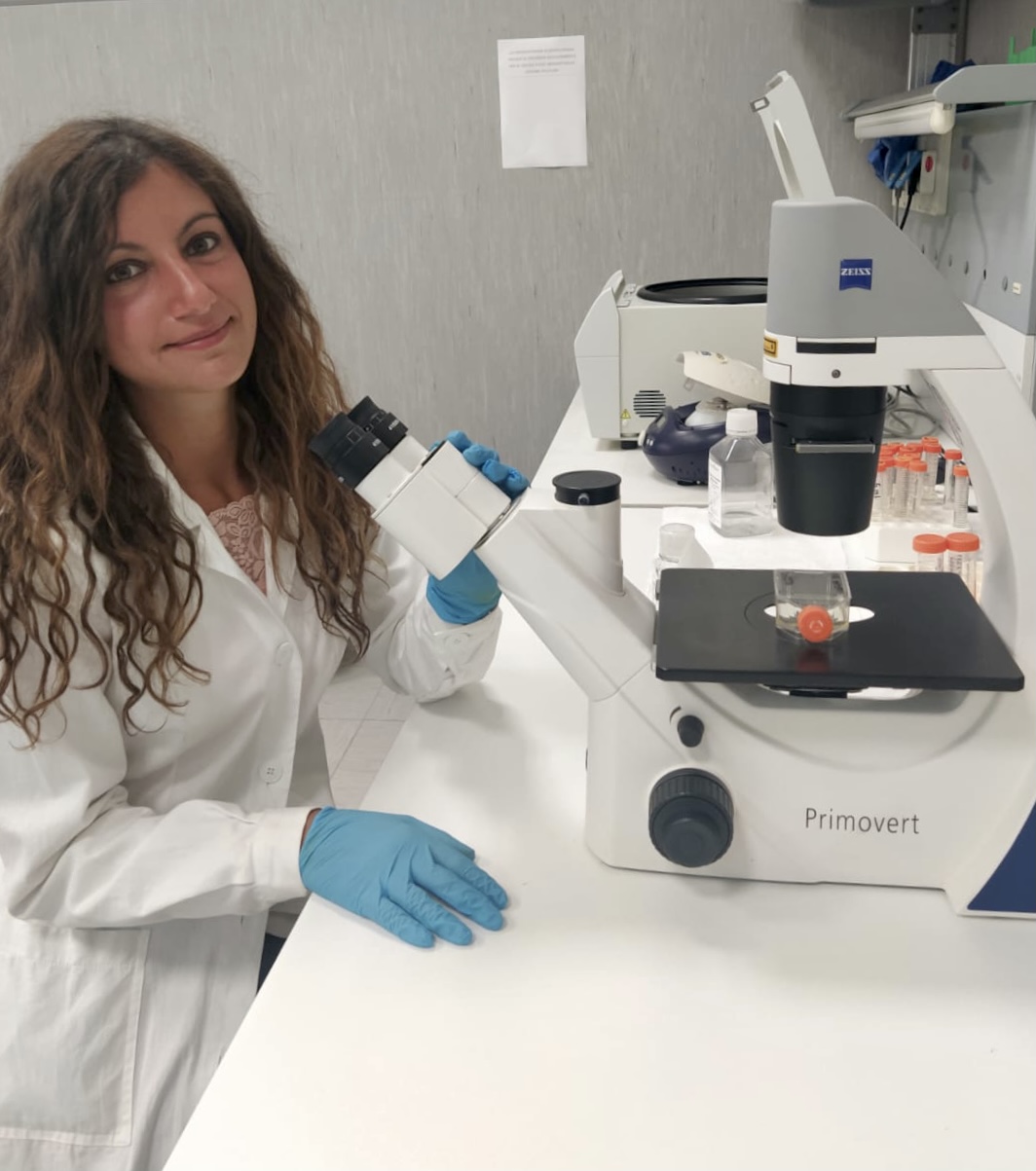
Donatella Delle Cave received her Master’s degree in Industrial and Molecular Biotechnology from the University of Naples Federico II in 2014. She earned her PhD in Biochemical and Biotechnological Sciences from the University Vanvitelli (2014–2017), investigating the antiproliferative effects of S-adenosylmethionine and its regulation of microRNAs in breast cancer and osteosarcoma. In 2018, she joined Dr. Enza Lonardo’s Gastrointestinal Cancer Laboratory, studying the crosstalk between cancer cells and the tumor microenvironment in pancreatic ductal adenocarcinoma (PDAC) and colorectal cancer (CRC). Her postdoctoral research integrates multi-omics, cell biology, CRISPR/Cas9 gene editing, and preclinical models, demonstrating that stromal TGF-β1 promotes metastasis, stemness, and chemoresistance in PDAC by modulating L1CAM and LAMC2 expression (Cell Death and Disease 2025; Oncogene 2020; JECCR 2022). As a Visiting Scientist at Universidad Autónoma de Madrid (2021), she investigated metabolic alterations in PDAC. In CRC, using patient-derived organoids, she showed that hypoxia- and Nodal-induced L1CAM/CXCR4 drive liver metastasis, which can be reduced in vivo by combining 5-fluorouracil with Nodal inhibition (Theranostics 2021). She also developed nanosystems for controlled Galunisertib delivery in CRC, functionalized with anti-L1CAM antibodies to target metastatic cells (Int J Nanomedicine 2024; Small 2021). Currently, her research at IGB-CNR is funded by the My First AIRC Grant (MFAG 2024–2029) and focuses on the role of the matrisome in PDAC progression and metastasis. Donatella has been awarded four postdoctoral fellowships (from Fondazione Italiana per la Ricerca sulle Malattie del Pancreas – FIMP – and Fondazione Umberto Veronesi), as well as competitive grants from FIMP (2023), AIRC (MFAG 2024), DSB-CNR (2024), SEELIFE (2025), and the Novogene Italian Sequencing Project Award (2025). Her honors include the Italian National Scientific Qualification in General Pathology and Applied Biology (2025–2037), the Lisa de Conciliis Award for organoid and bioengineering research in CRC (2024), several travel grants, best poster awards, and an Erasmus Traineeship at CIC bioGUNE, Spain (2017). She has also served as Chair at ISCAM conferences (2022, 2025) and as Scientific Secretary for the IGB Workshop (2021).