

Senior Researcher
 +39 081 6132 257
  francesca.fusco@igb.cnr.it
Genetics, Genomics and Epigenetics of Diseases
Keywords: Human Molecular Genetics, Rare Diseases, X-linked diseases, Incontinentia pigmenti disease, Genetic Biobank
My research focuses on the molecular mechanisms underlying genetic diseases, with particular emphasis on genotype-phenotype correlations in the X-linked rare disorders Incontinentia Pigmenti (IP; OMIM#308300) and Anhidrotic Ectodermal Dysplasia with Immunodeficiency (EDA-ID; OMIM #300291). Both disorders are characterized by dysregulated inflammatory responses and may present with autoimmunity and immunodeficiency.
My research aims to elucidate the molecular, cellular, and immunological mechanisms underlying disease onset and progression, identify diagnostic/prognostic biomarkers, and characterize therapeutic targets to support personalized medicine. A major focus is the study of complex rearrangements at the NEMO/IKBKG locus and their contribution to IP pathogenesis, including germline and somatic mosaicism. These studies support a model in which tissue-specific disease manifestations result from interactions among genetically distinct cell populations.
A complementary research line integrates genomic and transcriptomic sequencing, deep phenotyping, and family-based studies to identify genetic variants associated with neurological and subclinical autoimmune manifestations in IP. To support this research, we established the Incontinentia Pigmenti Genetic Biobank (IPGB genetic Biobank), hosted at CRB-IGB, integrating biological samples with clinical and genetic data. Since 2015, I have served as Head of IPGB, since 2016 as a BBMRI.it member, since 2018 as a member of the CRB-IGB-CNR Board of Directors, since 2024 as CRB-IGB Coordinator.
Studies of the pathogenesis of human X-linked rare disease
We are interested to characterize the genetic aberrant mechanisms able to produce complex rearrangements in the NEMO/IKBKG locus, causing Incontinentia pigmenti.
The IP locus has an intrinsic genomic instability able to predispose to the generation of novel rearrangements by different mechanisms during either meiotic or mitotic cellular division.
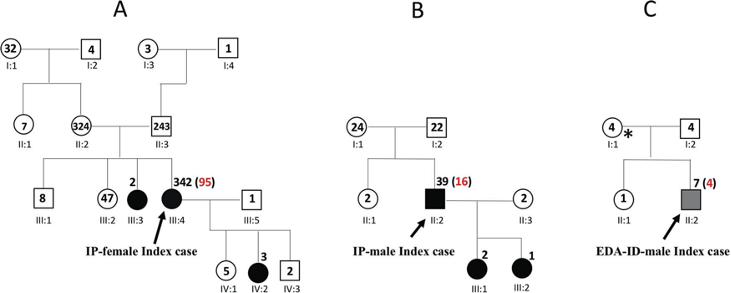
Mosaicism germinal and somatic, revealed in male patients affected by IP, has reinforced model that the IP pathogenesis based not only on the cellular effects of an impaired NEMO protein activity, but also derives from the context of the interaction of genetically different cells in the affected tissue.
Genetic and genomic aspects in genotype-phenotype correlation in human X-linked rare disease, Incontinentia pigmenti
This research line combines genomic/transcriptomic sequencing approaches and deep phenotyping analysis by IP family based-studies to identify rare or common variants associated to form of IP with neurological defects or with specific silent autoimmunity recently revealed in IP patients by SARS-CoV2 pandemic impact. We have built Incontinentia Pigmenti Genetic Biobank (IPGB genetic Biobank, http://www.igb.cnr.it/ipgb) located in CRB-IGB institute, that is the largest IP sample collection and one of the largest rare-disease-oriented collections in the world and including the clinical and genetic information. By improving our collaboration with national and international Association of IP patients we aim to collect samples and data of IP patients worldwide by high-quality procedures to facilitate comprehensive translational research and personalized treatment
IPGB biobank and historical collection of IP samples and data (Fusco et al., 2019)
Spinosa E, Rosain J, Picascia S, Salvia M, Pescatore A, Torella A, Piluso G, Nigro V, Piccolo V, Diociaiuti A, Di Biase I, El Hachem M, Lioi MB, Bastard P, Ursini MV, Fusco F. A case of Incontinentia Pigmenti associated with concurrent IKBKG/NEMO and MED13L mutations. Front Med (Lausanne). 2026 Jun 18;13:1819035. doi:10.3389/fmed.2026.1819035. eCollection 2026. PMID: 42396138.
Wilson R, Somani N, Arias N, Berrocal A, Chen C, Chen X, Cole E, Ehrich P, Faupel TC, Ferrone P, Fete T, Fete M, Fusco F, et al. Report From the International Conference on Incontinentia Pigmenti: Translating Discovery to Therapy. Am J Med Genet A. 2026 May 11. doi:10.1002/ajmg.a.70195. Online ahead of print. PMID: 42109079.
Rosain J, Le Voyer T, Liu X, Gervais A, Polivka L, Cederholm A, Berteloot L, Parent AV, et al. Incontinentia pigmenti underlies thymic dysplasia, autoantibodies to type I IFNs, and viral diseases. J Exp Med. 2024 Nov 4;221(11):e20231152. doi:10.1084/jem.20231152. Epub 2024 Oct 1. PMID: 39352576; PMCID: PMC11448874.
Sanchez Gonzalez MDC, Kamerling P, Iermito M, Casati S, Riaz U, Veal CD, Maini M, Jeanson F, Benhamed OM, van Enckevort E, Landi A, Mimouni Y, Le Cornec C, Coviello DA, Franchin T, Fusco F, Ramírez García JA, van der Zanden LFM, Bernier A, Wilkinson MD, Mueller H, Gibson SJ, Brookes AJ. Common conditions of use elements. Atomic concepts for consistent and effective information governance. Sci Data. 2024 May 8;11(1):465. doi:10.1038/s41597-024-03279-z. PMID: 38719810; PMCID: PMC11078919.
Matuozzo D, Talouarn E, Marchal A, Zhang P, Manry J, Seeleuthner Y, Zhang Y, et al. Rare predicted loss-of-function variants of type I IFN immunity genes are associated with life-threatening COVID-19. Genome Med. 2023;15:22. doi:10.1186/s13073-023-01173-8. PMID: 37020259; PMCID: PMC10074346. Member of COVID Clinicians.
Pescatore A, Spinosa E, Casale C, Lioi MB, Ursini MV, Fusco F. Human Genetic Diseases Linked to the Absence of NEMO: An Obligatory Somatic Mosaic Disorder in Male. Int J Mol Sci. 2022;23:1179. doi:10.3390/ijms23031179.
Asano T, Boisson B, Onodi F, Matuozzo D, Moncada-Velez M, Maglorius Renkilaraj MRL, et al. X-linked recessive TLR7 deficiency in ~1% of men under 60 years old with life-threatening COVID-19. Sci Immunol. 2021;6:eabl4348. doi:10.1126/sciimmunol.abl4348. Members of COVID Clinicians.
Bastard P, Gervais A, Le Voyer T, Rosain J, Philippot Q, Manry J, Michailidis E, et al. Autoantibodies neutralizing type I IFNs are present in ~4% of uninfected individuals over 70 years old and account for ~20% of COVID-19 deaths. Sci Immunol. 2021;6:eabl4340. doi:10.1126/sciimmunol.abl4340. Member of COVID Clinicians.
Bastard P, Rosen LB, Zhang Q, Michailidis E, Hoffmann HH, Zhang Y, Dorgham K, et al. Autoantibodies against type I IFNs in patients with life-threatening COVID-19. Science. 2020;370(6515):eabd4585. doi:10.1126/science.abd4585. Epub 2020 Sep 24. PMID: 32972996.
Note: #Repubblica Press Releases, “Covid, il 15% delle forme gravi dipende dalla genetica. Studio su Science”, 24/09/2020. RepubblicaNote: #CNR Press Releases, Roma, “Covid-19: il 15% delle forme gravi spiegato da anomalie genetiche e immunologiche”. CNR
Zhang Q, Bastard P, Liu Z, Le Pen J, Moncada-Velez M, Chen J, Ogishi M, Sabli IKD, Hodeib S, Korol, et al. Inborn errors of type I IFN immunity in patients with life-threatening COVID-19. Science. 2020;370(6515):eabd4570. doi:10.1126/science.abd4570. Epub 2020 Sep 24. PMID: 32972995. #Repubblica Press Releases, “Covid, il 15% delle forme gravi dipende dalla genetica. Studio su Science”, 24/09/2020. Repubblica; #CNR Press Releases, Roma, “Covid-19: il 15% delle forme gravi spiegato da anomalie genetiche e immunologiche”
Bodemer C, Diociaiuti A, Hadj-Rabia S, Robert MP, Desguerre I, Manière MC, de la Dure-Molla M, De Liso P, Federici M, Galeotti A, Fusco F, Fraitag S, Demily C, Taieb C, Valeria Ursini M, El Hachem M, Steffann J. Multidisciplinary consensus recommendations from a European network for the diagnosis and practical management of patients with incontinentia pigmenti. J Eur Acad Dermatol Venereol. 2020;34(7):1415-1424. doi:10.1111/jdv.16403. PMID: 32678511.
Fusco F, Pescatore A, Steffann J, Bonnefont JP, De Oliveira J, Lioi MB, Ursini MV. Clinical utility gene card: for incontinentia pigmenti. Eur J Hum Genet. 2019;27(12):1894-1900. doi:10.1038/s41431-019-0463-9. Epub 2019 Jul 9. PMID: 31289372; PMCID: PMC6871521.
Fusco F, Valente V, Fergola D, Pescatore A, Lioi MB, Ursini MV. The Incontinentia Pigmenti Genetic Biobank: study design and cohort profile to facilitate research into a rare disease worldwide. Eur J Hum Genet. 2019;27(10):1509-1518. doi:10.1038/s41431-019-0451-0. Epub 2019 Jun 23. PMID: 31231133; PMCID: PMC6777495.
Fusco F, Conte MI, Diociaiuti A, Bigoni S, Branda MF, Ferlini A, El Hachem M, Ursini MV. Unusual Father-To-Daughter Transmission of Incontinentia Pigmenti due to Mosaicism in IP Males. Pediatrics. 2017:e20162950. doi:10.1542/peds.2016-2950. Note: #CNR Press Releases, Roma, 10/08/2017, “Incontinentia pigmenti: l’ereditarietà è anche paterna”.
Fusco F, Pescatore A, Conte MI, Mirabelli P, Paciolla M, Esposito E, Lioi MB, Ursini MV. EDA-ID and IP, Two Faces of the Same Coin: How the Same IKBKG/NEMO Mutation Affecting the NF-κB Pathway Can Cause Immunodeficiency and/or Inflammation. Int Rev Immunol. 2015;34:445-459. doi: [non indicato].
The complete list of publications is available on Google Scholar
Link a google scholar: https://scholar.google.com/citations?hl=it&user=cib4LSoAAAAJ
Orcid https://orcid.org/0000-0002-7578-6058
Scopus: Author ID: 7006608197
(https://www.scopus.com/authid/detail.uri?authorId=7006608197)
EDUCATION
- 2006: post-degree in Food Sciences and Nutrition Federico II University of Naples,
- 2000: PhD in Molecular and Cellular Genetics Federico II University of Naples,
- 1995: Degree in Biological Science Naples, Federico II University of Naples
RESEARCH AND PROFESSIONAL EXPERIENCE
- 2023: present CNR Senior Researcher, IGB-CNR, Naples
- 2010 -2023: CNR Researcher, IGB-CNR, Naples.
- 2002 -2010: Senior PostDoc fellow IGB- CNR, Naples.
- 2000-2002: Junior PostDoc fellow “Federico II” University of Naples
- 1996-2000: PhD student in Genetics Federico II” University of Naples
- 1993-1995: degree training, IGB-CNR, Naples
AWARDS AND HONORS
- 2025 Appointed Member by the General Director of the Unit to support the Scientific Network Center for Ethics and Integrity in Research- “CID Etica – “CID Etica – Biobanking Unit
- 2024 Elected Coordinator of the Center for Biological Resources of the Institute of Genetics and Biophysics ABT (CRB-IGB)
- 2023 Appointment of BioBank Processing Manager “Incontinentia Pigmenti Genetic Biobank”
- 2021 Member of CNR Immunology Network (CIN)
- 2019 Moderator Human Disease Genes website for IKBKG gene
- 2017-2019 Member of BBRMI Working group ELSI for rare patients
- 2017 Qualified as Associate Professor in Genetics (05/I1)
- 2016-present Manager for BBRMI of IPGB, Incontinentia Pigmenti Genetic Biobank at the Institute IGB-CNR in Naples
- 2015- present Manager of Incontinentia Pigmenti Genetic Biobank, IPGB -CNR
- 2015- present Responsible for managing records for the collection of genetic and clinical data of IP patients and principal investigator for the project “Establishment of a genetic biobank for Incontinentia pigmenti”, at the Institute IGB-CNR in Naples.
- 2013- present Active database curator for the IKBKG/NEMO gene mutations in Leiden Open Variation Database (LOVD)
Publications
Author of >40 publications, 6 e book chapters, and one patent National Patent N° 0001423541; n.PZ2014A00004; riferimento CNR: 10315.
The complete list of publications is available on Google Scholar
Link a google scholar: https://scholar.google.com/citations?hl=it&user=cib4LSoAAAAJ
Orcid https://orcid.org/0000-0002-7578-6058
Scopus: Author ID: 7006608197
(https://www.scopus.com/authid/detail.uri?authorId=7006608197)
Selected Research Support
Senior Researcher Partecipant: Sviluppo sperimentale e innovazione collaborativi nel campo delle malattie rare – “Accordo per la Coesione” della Regione Campania del 17 settembre 2024 – Intervento n° 2 – Progetto MAlattie RAre Diagnosticate e nON diAgnosticate in ambito neurologico, muscolo scheletrico e immunitario dalla diagnosi genetica innovativa ai modelli malattia e alla sperimentazione terapeutica preclinica: MARADONA CUP B63C25000260002 (2025-2027)
Principal Investigator: Project: Incontinentia Pigmenti Genetic Biobank. IPASSI Funding Agency: IPASSI (Italian Association of Incontinentia Pigmenti) (2022-2026)
Principal Investigator: NextGenerationEU (D.D. MUR Prot. n. 0001554 of 11/10/2022): Spoke 1, Work Package 1, “One Health Basic and Translational Research Actions addressing Unmet Needs on Emerging Infectious Diseases” (PE00000007). (2023-2025)
Researcher Partecipant BBMRI PNRR PROGETTO IR0000031 “Strengthening of the Biobanking and Biomolecular Resources Research Infrastructure of Italy” (Acronimo: BBMRI.it) (2022-2025)
+39 0816132257 ezia.spinosa@igb.cnr.it
Project Title:“Studio dei meccanismi molecolari e genetici alla base della patologia ‘Incontinentia Pigmenti’ e utilizzo di strategie omiche per la correlazione genotipo fenotipo”
Corso di Laurea Magistrale in Biotecnologie Mediche, Dipartimento di Medicina Molecolare e Biotecnologie Mediche, Università degli Studi di Napoli, Federico II
Project Title: “Identificazione delle alterazioni genetiche coinvolte nella patogenesi dell’Incontinentia Pigmenti”